
Operating at scale for Super Bowl LX
How Metropolis delivered seamless mobility and access across one of the world’s most demanding environments
Super Bowls are among the most operationally complex live events in the world. For Super Bowl LX, that complexity extended beyond Levi’s Stadium to the entire Bay Area.
More than 135 million people watched in the United States while hundreds of thousands moved across the Bay Area over the course of the week, including fans, league executives, media, sponsors, performers and members of both the Seattle Seahawks and New England Patriots organizations and families.
The 60th Super Bowl operated as a multi-city system spanning Santa Clara, San Jose and San Francisco, with dozens of official venues, layered security perimeters and constantly shifting schedules that demanded precise coordination.
Metropolis’ GAMEDAY team — a specialized group managing the high-stakes logistics, guest services and transportation for the world’s premier live events — has supported Super Bowl transportation and logistics continuously since 1999. The team brought decades of familiarity with the NFL’s operational requirements into planning for this year’s event.
For leagues, host committees and venue operators, the objective was straightforward: Coordinate on-schedule movement safely and predictably across a region operating at full capacity. Behind the scenes, we delivered the infrastructure, systems and operational teams that made this coordination possible.
Experience that performs under pressure
Our GAMEDAY team has operated at the highest level for more than 25 years. Super Bowl LX demanded and reflected experience built across the College Football Playoffs, NCAA Final Fours, NBA All-Star Games and every Super Bowl since 1999.
That experience spans more than 180 major live events worldwide and shows its value in our planning discipline, staffing models and real-time decision-making. Our work extends across NFL stadiums, major arenas, convention centers and dense urban environments where timing, security and access must operate in lockstep.
At this scale, complexity compounds quickly. By the time Super Bowl week began, operational plans were already established through months of coordination and rehearsal. Like the teams on the field, our success is the result of preparation, repetition and clearly defined roles.
Executing transportation and mobility at scale
We began planning for Super Bowl transportation and access more than a year ago, allowing agencies, venues and operators to align early on routes, staffing and contingency plans.
During Super Bowl week, GAMEDAY team members delivered end-to-end transportation and mobility operations across many event-related venues, coordinating movement across multiple cities, agencies and security environments.
That work included comprehensive management across the following high-stakes functions:
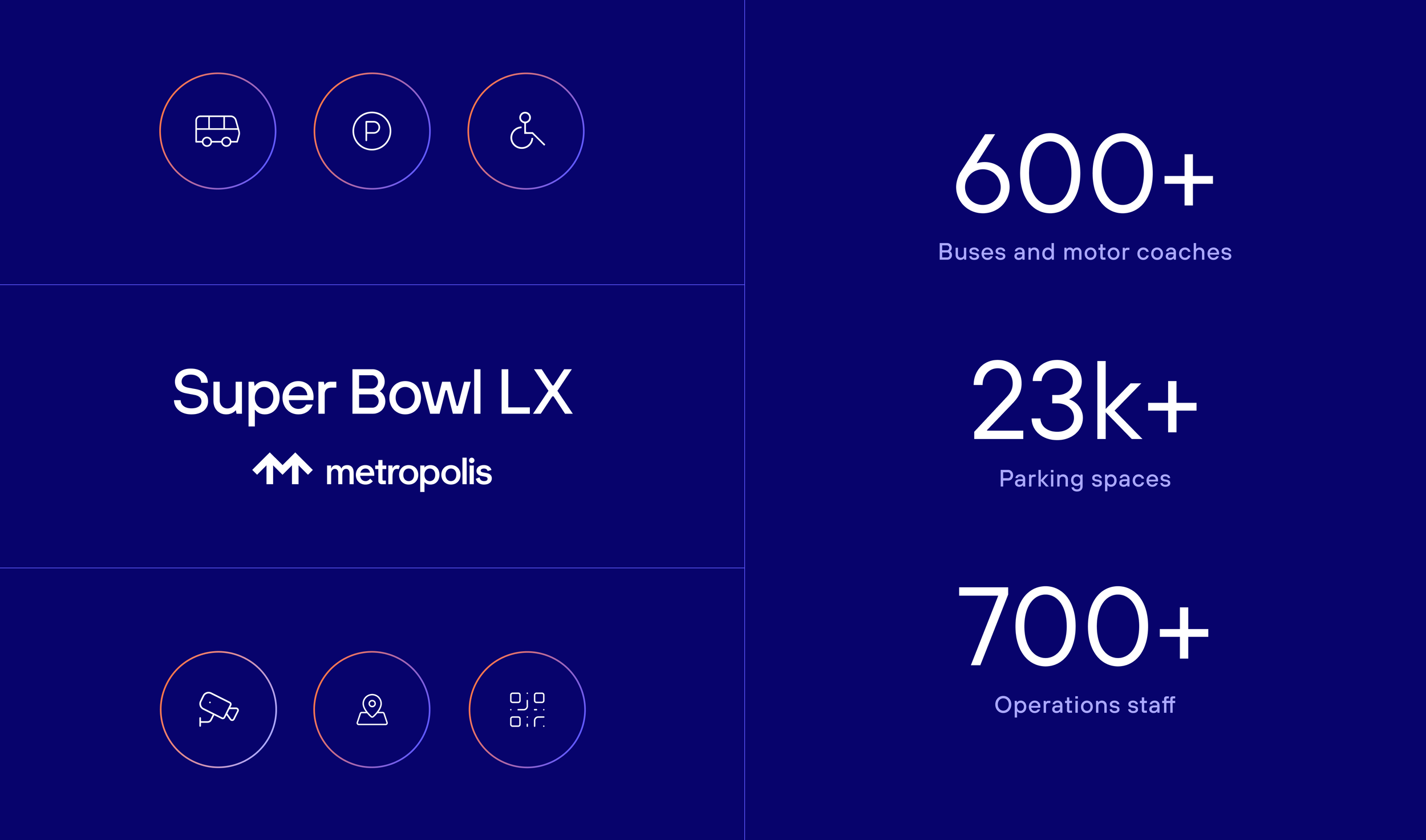
Bussing: Coordinated 600+ buses, including motor coaches, mini buses and school buses
Parking: Managed parking for 23,000+ spaces
Transit: Partnered with VTA and CalTran to incorporate plans for fans at Levi’s Stadium
Security: Operated across multiple security perimeters in close coordination with law enforcement and NFL Security
Permitting: Designed and executed parking and permit strategies, including ADA access
Accessibility: Provided on-site mobility assistance for hundreds of attendees
Navigation: Managed downtown venue transportation, including vehicular routing, pedestrian pathways, access control and real-time wayfinding
For fans and guests, the Super Bowl unfolded as expected. Arrivals were on time. Departures moved smoothly. Accessibility was addressed efficiently. Movement across venues remained orderly, even as security postures shifted and demand peaked throughout the week.
Recognition without announcement
The Recognition Economy’s operating principles allow systems to recognize context, coordinate across environments and enable action without requiring attention from the end user. Intelligence is applied upstream, complexity is handled behind the scenes and outcomes are delivered without interruption.
This model plays out every day for more than 23 million Metropolis Members across 4,200 locations, where access, movement and payment function automatically.
At Super Bowl LX, we applied those principles at regional scale. We planned transportation flows early and adjusted them continuously. We executed access accurately across multiple cities and worked with partners as plans needed to respond to real time situations.
The result was a stable operating layer that allowed people to move predictably through one of the most complex live environments in the world.
Our technology enabled coordination and visibility. Our people applied judgment and maintained continuity. The system did what it was designed to do.
This is functional recognition in practice: orchestration without friction, performance without distraction.
The culmination, not the exception
When transportation, mobility and access operate seamlessly at this scale, the outcome can feel inevitable. It’s not. It’s built through discipline, repetition and trust earned over decades of live operations.
The 2026 Super Bowl was not a deviation from how Metropolis operates. It was a concentrated representation of it.