
From arrival to kickoff: How Metropolis helps move fans through the 2026 World Cup
The 2026 World Cup is the largest in the tournament’s history, spanning three countries and 16 cities in North America. Every successful match day depends on an invisible network of mobility infrastructure — parking, airports, transit systems, shuttles, security.
Metropolis is supporting the movement of millions of fans through host cities, drawing on decades of experience managing complex transportation, parking and event operations at some of the world’s largest live events, including the Super Bowl.
Our teams are operating across the tournament to ensure that fans coming from all over the world can move seamlessly through multiple host cities to get to what matters most: the matches.
Built to keep fans moving
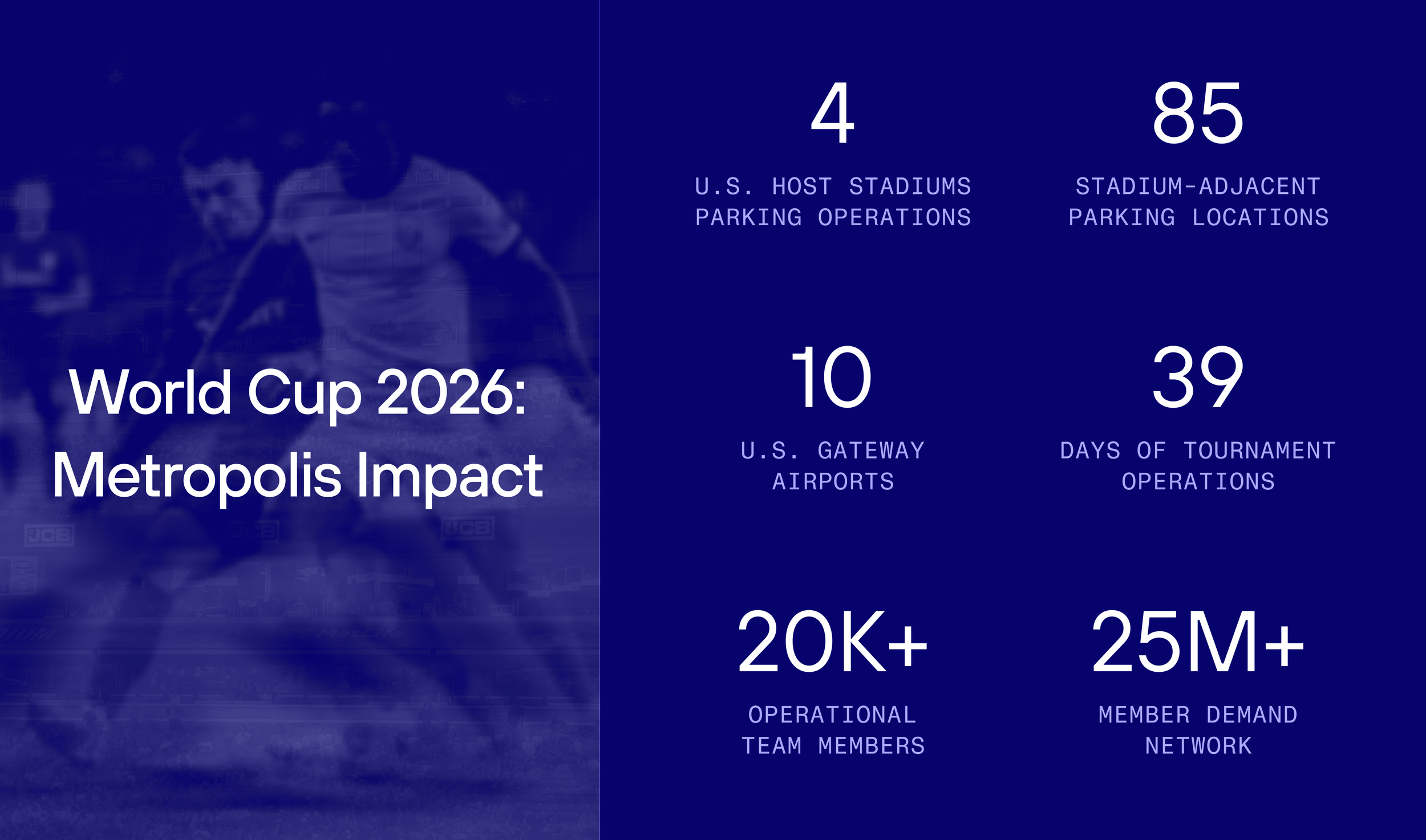
Metropolis manages parking at four World Cup host venues in Philadelphia, Atlanta, Los Angeles and New York/New Jersey. Beyond the stadiums, 85 Metropolis-operated lots near host venues and fan fests across 11 host cities in the United States and Canada are accepting online reservations throughout the tournament.
Bags, our concierge luggage service, and AeroParker, our airport parking reservation platform, are running across all 10 World Cup gateway airports in the U.S.
And GAMEDAY, our team of major live event logistics veterans, is managing shuttle operations for Philadelphia’s official FIFA Fan Festival for all 39 days of the tournament.
Gateway to the World Cup
For millions of fans arriving from around the world, the journey to the match starts long before kickoff. Metropolis is present at each step.
Bags is available at all 10 U.S. gateway airports — ATL, BOS, DFW, HOU, LAX, EWR, PHL, SFO, SEA and MCI — through select airlines. Remote check-in is live in San Francisco for travelers who want to clear baggage before they even reach the venue market.
For domestic fans planning ahead, AeroParker reservations are active across every gateway market. No ticket, no QR code, no queue.
Operational experience at scale
Managing the complexity of a 39-day series of operational peaks unfolding simultaneously at venues across the continent requires expertise and systems that can adapt in real time.
Our GAMEDAY team has supported Super Bowl operations continuously since 1999. At Super Bowl LX earlier this year, the team coordinated 600+ buses, managed 23,000+ parking spaces and ran transportation and logistics across multiple cities and security zones.
While the World Cup presents a different kind of challenge, that experience — the systems, staffing models and real-time decision making — is coming into play. The Metropolis team impacts the movements of fans from airports to parking for matches in host markets from coast to coast.
Talent + invisible technology
The best infrastructure goes unnoticed because it simply works. Across World Cup host markets, Metropolis is supporting critical touchpoints throughout the fan journey — from airports and baggage services to parking operations, transportation logistics and venue access.
Behind the scenes, a team of 20,000+ is working to get fans where they’re going without friction or delay. On the world’s biggest stage, in the most complex environments, Metropolis is demonstrating how operational expertise and technology can work together at unprecedented scale.
This is the foundation of the Recognition Economy, which is reshaping how we engage with the physical world. With recognition-powered technology, access becomes instant. Payments become invisible. Everything works as it should.
The matches will be remembered for the moments on the pitch. The infrastructure making those moments possible — the systems and teams that millions of fans will never think twice about — is setting a new standard for how people move through the world.