
Unlocking the next era of movement
Devin Lee, Nick Johnson, Robin Riedel
December 16, 2025
Mobility is about to undergo an unprecedented transformation. Autonomous vehicles, delivery droids and drones and electric vertical take-off and landing aircraft (eVTOLs) are moving from trials to scale up, supported by smart infrastructure that connects and coordinates them. By the end of the decade, these technologies will converge to create more convenient, faster, cleaner and smarter movement across road, curb and air. This is not simply about replacing conventional modes of transportation, it is about building an intelligent network that unlocks new ways to travel and move goods and new opportunities for cities, operators, customers and asset owners.
We’re increasingly stuck, but there are solutions on the horizon
The average American driver lost 49 hours to traffic congestion in 2025; more than a full work week spent motionless on congested roads, at best half-listening on a conference call. The cost is significant; this stagnation translates to close to 4.7 billion hours wasted and roughly $85 billion in lost productivity. What is most vexing is that time is not a renewable resource — we can’t simply make more of it. Similarly, while home delivery of prepared foods and other items has truly taken off over the past year, too often deliveries are delayed in traffic; too often fries arrive soggy.
The good news is these challenges are finally becoming solvable. A new generation of mobility technologies is emerging, including autonomous fleets, eVTOLs, and delivery droids and drones. Yet, their true potential depends on something deeper: smart infrastructure. Roads, curbs, parking and charging assets and airspace must be able to recognize, predict and coordinate movement in real time, transforming static environments into adaptive systems. This intelligence is what allows new modes to scale safely, efficiently and sustainably. What we are witnessing is not a collection of isolated upgrades, but a systemic shift in how people and goods move through cities and beyond; and it is unfolding right before our eyes.
The smart infrastructure opportunity
Mobility challenges are no longer solved by better vehicles alone. Autonomous systems require reliable places to operate; locations to stage, charge, park, land, take off, be serviced, load and hand off passengers or goods. When infrastructure cannot digitally identify, authorize and coordinate these interactions, autonomy breaks down at the moments that matter most.
Today, infrastructure often acts as a bottleneck: A self-driving car cannot simply pull a parking ticket and pay at a pay station. Delivery drones cannot scale without networked nests close to pick-up and drop-off locations for landing, charging and redeployment. eVTOL aircraft cannot expand without certified vertiports that support passenger services, charging and ground operations. Without smart infrastructure, new mobility modes remain constrained by legacy rules and static design.
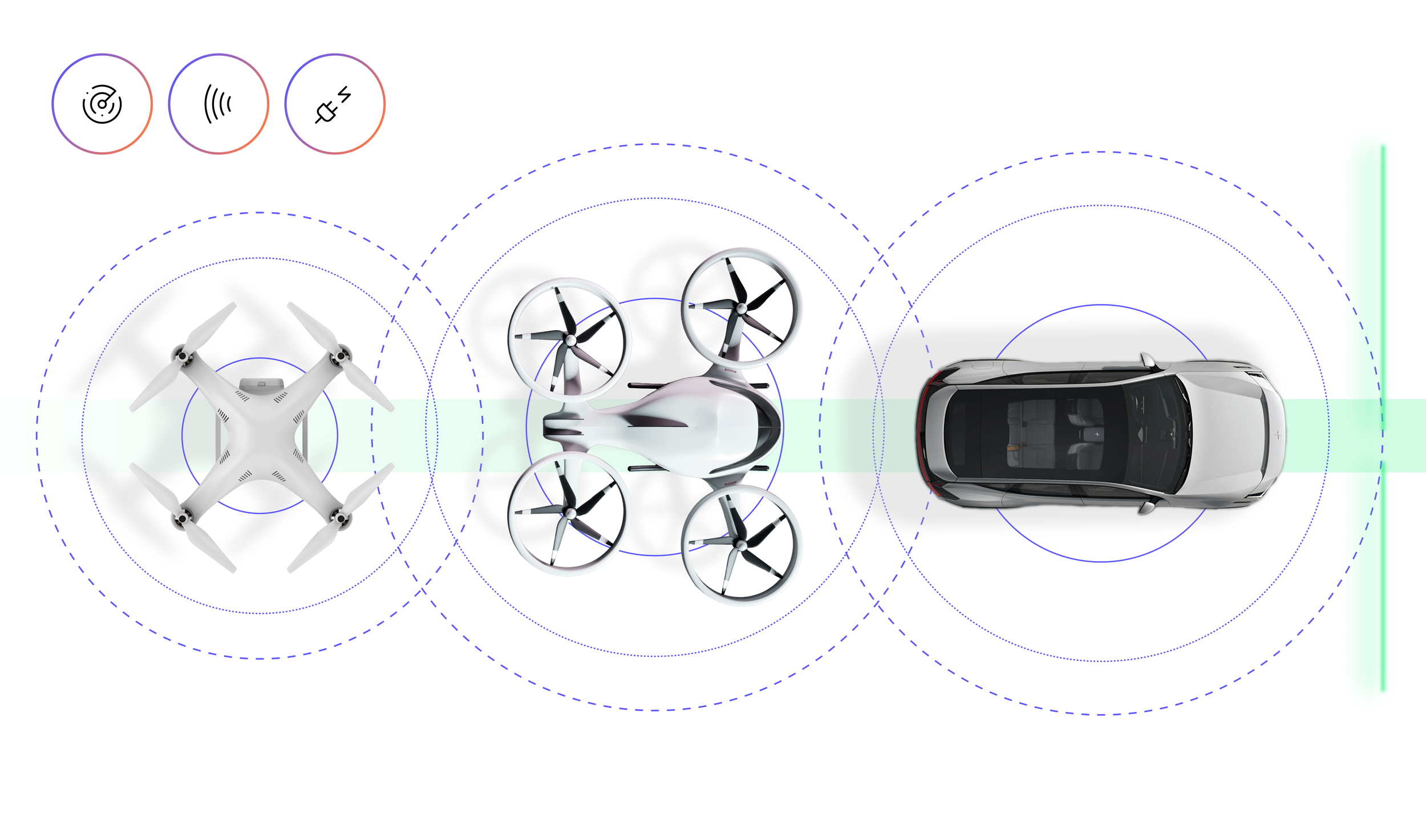
Smart infrastructure comprises physical assets embedded with sensors, connectivity and software that make them machine-readable and machine-operable and deliver a seamless user experience for humans. Garages, curbs, depots, rooftops and vertiports can manage access, enable bookings, report live status and coordinate movements across vehicles and modes, transforming passive assets into active nodes in the mobility ecosystem.
For real estate and infrastructure owners, this reframes mobility from disruption into opportunity. Not every asset will participate, but those that do become high-value operational nodes that bring new and diverse revenue streams, attract premium partners and increase overall utilization and NOI.
Source: Metropolis analysis
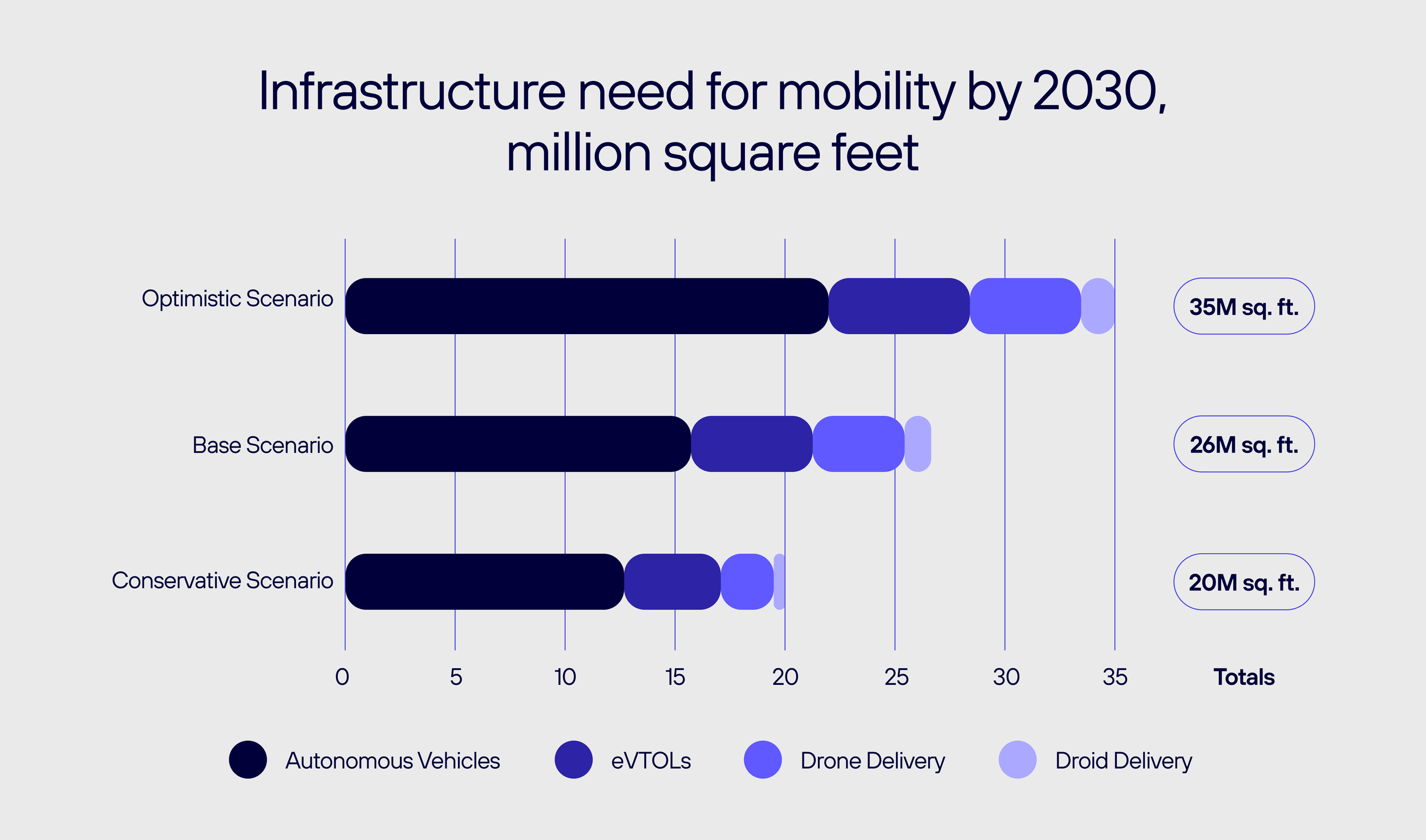
In our base scenario, more than 25 million square feet of infrastructure, or roughly 150,000 standard parking spaces, will need to be enabled with smart systems in the United States by 2030 to support this emergence of new mobility modes. This includes space for autonomous vehicle and delivery fleet charging, drone landing and charging nests and eVTOL vertiports integrated into existing assets.
The two forces accelerating demand for smart infrastructure: autonomy and vertical mobility
The push for smart infrastructure is being driven by two forces already reshaping mobility: autonomy and vertical mobility. Together, they increase the scale, speed and complexity of transportation and place new demands on the infrastructure that supports it.
Autonomy is transforming ground transportation by turning vehicles into continuously operating systems. Robotaxis, delivery droids and autonomous freight depend on infrastructure that can digitally authenticate access, manage dwell time, coordinate charging and support high-frequency operations.
Momentum is already visible. The global autonomous vehicle market size was estimated at ~$70 billion in 2024 and is projected to reach over $200 billion by 2030, according to Grand View Research. In San Francisco, Waymo has already captured over 25% of the city’s rideshare market, according to Bond Cap. Tesla and Zoox are also aiming to grow their presence across the country. What limits further expansion is no longer vehicle capability, but the availability of smart, autonomy-ready places to operate.
Vertical mobility adds a new layer. eVTOL aircraft enable passenger and cargo transport without runways, while delivery drones already move parcels and medical supplies autonomously in the United States.The urban air mobility market is projected to reach ~$20 billion by 2030, up from $5 billion in 2024, according to Grand View Research. Commercial eVTOL operations are expected to begin in multiple cities within the next 18 months, led by players like Archer, Beta Technologies and Joby Aviation. Delivery drone players like Flytrex, Manna, Wing and Zipline are already operating drone delivery services in the United States and international markets. As with autonomy, the gating factor is infrastructure: vertiports, charging systems and digitally integrated ground operations.
Together, autonomy and vertical mobility are shifting transportation from a vehicle-centric system to an infrastructure-centric one. Decisions about where to locate vertiports, how to allocate curb and garage space, how to facilitate charging and servicing and which operational standards to adopt will shape how quickly these modes scale.
Our vision for the next era
The previous era of mobility delivered personal autonomy. The next era will deliver intelligent mobility that is enabled by smart infrastructure that connects land, air and digital networks.
At Metropolis, we partner with cities, developers, asset owners and new mobility leaders to design and operate infrastructure ready for the autonomous and vertical mobility era. Our approach prioritizes operational efficiency, asset value creation and user experience, while maintaining safety, reliability and regulatory compliance — all to increase NOI and support scaling of new mobility with all its promises
By taking a long-term, integrated approach, Metropolis positions itself as both a builder and operator of smart mobility infrastructure, transforming static assets into essential platforms for the future of transportation.